
Talking Solana; SEC Democrat Blasts Rule Delay; Senators Grapple With Stablecoin Bankruptcy
Capitol Account: Free Weekly Edition
There’s no summer slowdown yet in financial regulation news. CFTC chairman nominee Brian Quintenz finally got a hearing in the Senate Agriculture Committee. The Andreessen Horowitz crypto policy chief faced a few questions about his industry ties, but appears to be on a glide path to confirmation. Treasury Secretary Scott Bessent was a ubiquitous presence on Capitol Hill this week, testifying three times. He admitted to being jet-lagged after a quick trip to London for trade talks with China, but enjoyed punching back at Democrats who badgered him about tariffs and the president’s budget.
At the SEC, the lone Democratic commissioner strongly dissented on a seemingly mundane vote to extend a deadline for hedge and private equity funds to report on their trading activities. She saw much more at stake. We also took a look at an effort by the commission’s Republican majority to scrub one of Gary Gensler’s expansive legal theories from being enshrined as precedent in federal courts across the country. It is proving to be a difficult task.
And as the Senate comes closer to passing a landmark stablecoin bill, tricky issues continue to pop up. One that is gaining some last-minute attention: what happens when a token issuer goes bankrupt. For our Friday interview, we sat down with the CEO of the new Solana Policy Institute.
Thanks for reading our digest of articles published this week. Click the button below to become a paid subscriber and get our full coverage.
Friday Q and A: The digital assets crowd is poised for an auspicious summer. The Senate is on the cusp of passing bipartisan stablecoin legislation, a landmark effort that the Treasury secretary recently predicted could ramp up issuance of dollar-denominated tokens by a factor of ten. In the House, another industry-backed bill setting out a broad oversight framework was approved by two committees. Donald Trump is eager to sign both.
This week we sat down with veteran crypto advocate Miller Whitehouse-Levine, who’s been working to get the measures over the finish line. Positive momentum, he points out, is not the same as “durable wins” – getting laws enacted and rules written. That’s on the top of his agenda as the CEO of the Solana Policy Institute.
The group, founded in March, was set up to educate policy makers about public blockchains and their importance to the digital economy. Recently, Whitehouse-Levine has been showing some of the firms that build consumer-facing products on the Solana platform around D.C. It’s a different constituency than many lawmakers and regulators are used to seeing, and one he argues makes some of the esoteric aspects of the technology easier to comprehend. (And he should know, his prior gig was running the DeFi Education Fund.)
Read on to learn more about Whitehouse-Levine’s new job and why Solana is ramping up its Washington game. He also has some thoughts on the current legislative wrangling and the new leadership at the SEC. What follows is our (lightly edited and condensed) conversation.

Capitol Account: First, what is Solana?
Miller Whitehouse-Levine: Solana is a blockchain, very simple. Just like other blockchains, it’s a unique ledger that stores data in a way that is very difficult to alter. And the validity of which folks can ascertain, whoever they are, across the world.
CA: How is it different from the bitcoin blockchain?
MW-L: Bitcoin does one thing. It tracks…what wallets own what bitcoin…Ethereum and Solana tried to apply those innovations to create a general-use, public blockchain. Anyone can [use it to] program whatever they dream up.
CA: How long has Solana been around?
MW-L: Solana came along in 2020 and the vision was for a blockchain to serve as the infrastructure through which global commerce will occur in the future. It needs to be very fast and it needs to be highly scalable. There’s probably billions of transactions, payments conducted a day – and you need a highly scalable network in order to handle that.
CA: Is it working?
MW-L: I think the thesis has been borne out, largely. For example, last month, two-thirds of all transactions that folks conducted on blockchains happened on Solana. The growth has really been explosive. The same is true on the developer side. Last year, there were the most developers of any ecosystem building on Solana.
CA: And Solana has a token. What is it for?
MW-L: It’s the exact same in Solana, Bitcoin and Ethereum. The token is a native asset that is used to incentivize miners and validators to participate in the validation of the transaction ledger that comprises the blockchain. Why does the baker bake bread? Because people are going to buy the bread. For public blockchains, the token is the bread.
CA: What led you to start this new organization?
MW-L: I believe in the future of this technology, not for academic purposes but for real world applications and their ability to change people’s lives. I think that scalability, speed and cost efficiency are fundamental…It’s really about, how do we make this real today? And I think that is sometimes wanting in the crypto industry…There really is such a vast range of things being built on Solana.
CA: Why does Solana need a policy institute?
MW-L: If you’re not at the table, you’re on the menu in Washington. It’s cliche, but it’s absolutely true. And we want to make sure that Congress adopts tech-neutral policies that are going to allow everyone to compete with clear rules on the same terms for the next several decades.
CA: Who hired you?
MW-L: I pitched this idea. We’re [a nonprofit]. So I have a board of overlords.
CA: Who’s paying for it?
MW-L: We have multiple funders, folks who are interested in Solana succeeding.
CA: That sounds like you don’t disclose your donors.
MW-L: Exactly.
CA: Talk about some of your recent advocacy work.
MW-L: Last Thursday we had a roundtable and fly-in with a bunch of decentralized physical infrastructure projects building on Solana, [including] Geodnet [and] Hivemapper. [These types of projects] are super cool to bring to D.C. because they're highly tangible. Sometimes they actually have a physical product. The token is really just a means to an end, which I think is a different framing than folks in D.C. are used to thinking about with crypto.
CA: Meaning it’s less difficult to explain?
MW-L: Show-don’t-tell is certainly a good rule of thumb in D.C. Crypto is highly abstract, to even folks like me who work in the industry. We don't need to be [doing as much] selling when there are amazing things happening on chain that people can come and talk about in Washington…Their first reaction is: I didn’t know any of this could be done on a public blockchain…(Friday)
Click here to subscribe and read the rest of the interview.
Thanks for reading. Follow us on X @CapitolAccount and on LinkedIn by clicking here. We’re always looking for stories, so if you have any suggestions on what we should cover (or comments about Capitol Account), shoot us a note. Rob can be reached at: rschmidt@capitolaccountdc.com and Ryan at rtracy@capitolaccountdc.com. If somebody forwarded this to you and you’d like to subscribe, click on the button below. Please email for information on our special rates for government employees, academics and groups: subscriptions@capitolaccountdc.com.
Dissent: It didn’t take long for Paul Atkins’ second public meeting as chairman to burst into conflict over what seemed to be a mundane matter: adding a few months to the date when hedge and private equity funds are required to submit new confidential details about their trading activities. But the SEC chief quickly signaled that he had a more far-reaching motive in seeking the pause – and the commission’s lone Democrat was none too happy.
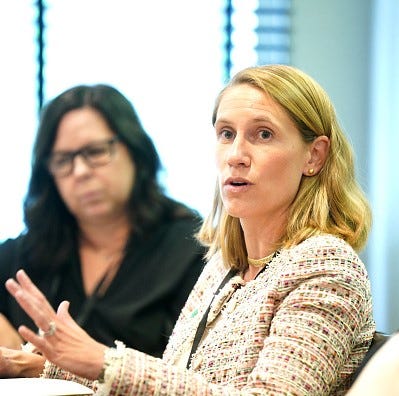
“There is certainly more here than meets the eye,” declared Caroline Crenshaw. “The reality of our action today is more complex – and more concerning.”
The contretemps, naturally, was over a regulation adopted under the Gensler regime: an update to a document known as Form PF. Instituted in the wake of the financial crisis, the filing is used by FSOC and other financial overseers to monitor systemic risk. But it has long rankled the mostly unregulated investment advisers who have to turn over reams of information to the government, an exercise they have called costly and overly burdensome.
Gensler’s rule, a joint effort with the CFTC, passed early last year and expanded the form significantly, demanding even more data. The private fund industry has been strenuously lobbying newly empowered GOP officials to scrap the plan. They had some initial success in January when both agencies kicked the compliance date several months down the road. But that ended up not being enough time: The requirements were scheduled to go live tomorrow.
The 3-1 SEC vote (and another approval by the CFTC, which didn’t hold a public meeting) gave funds until Oct. 1 to comply. However, Atkins emphasized that the commission staff will “undertake a comprehensive review” of the rule – and he indicated that major changes could be in store. “I have serious concerns whether the government’s use of this data justifies the massive burdens that it imposes,” he said.
Crenshaw blasted what she called “a last-minute request from some of the most highly sophisticated, highly resourced entities in our financial system.” And she said their contention that they need more time to coordinate with outside vendors “really doesn’t seem like much of a credible reason.” The truth, Crenshaw continued, is that the delay will allow the SEC to “revisit, or perhaps abandon, this information altogether.”
The commissioner also was suspicious about the timing of the SEC’s review, which she underscored “just so happens to be aligned with a powerful policy push” to open private markets to retail investors. “We can’t have it both ways,” she argued. “We can’t suggest that it’s perfectly safe and appropriate for investors of all stripes to gain exposure to these markets while we're going out of our way to put our head in the sand about what’s actually going on.”
In response, Atkins conceded that “it may be a little unusual” for the SEC to extend a compliance deadline at the last minute, but said it was necessary “to provide people time, so we get good data that has integrity.” He blamed “a rushed rulemaking process” under Gensler and explained that the SEC is now “reaping the fallout.” Market participants, he said, “rightly are asking some questions.”…(Wednesday)
Click here to subscribe and read the rest of the article.
Bankruptcy Quagmire: The bipartisan group of senators hammering out the stablecoin legislation has gone back and forth in recent weeks on a particularly knotty problem: What happens if a company issuing dollar-denominated digital tokens goes belly up? Solving it hasn’t been easy – and some last-minute opposition is forming.
The debate stems from a fundamental tension. Stablecoins are a method of payment, which means they function similarly to digital money in a bank account. But when a bank fails, deposits are federally insured. That’s not the case for the tokens – and the GENIUS Act’s drafters have been struggling to figure out a way to handle the collapse of a stablecoin issuer, one that ensures users don’t suddenly lose access to their money.
One option, which was jettisoned early on, would have been to create an FDIC-like resolution regime for stablecoins. Republicans, who are in the driver’s seat, were wary of expansions of the government safety net, according to people familiar with the negotiations. There was also a view that stablecoins are different from banks in fundamental ways. For example, they are supposed to be backed by other assets on a one-to-one basis.
In the end, lawmakers opted to deal with stablecoins via traditional bankruptcy. Whether that will work, however, is a matter of significant debate – including, it seems, among some of those working on the bill. The current draft asks regulators to study potential “gaps in bankruptcy laws” and report back to Congress in three years.

While the directive may help alleviate some concerns, the bankruptcy issue has recently been taken up by a cadre of liberal academics. They’ve been making the case – publicly and privately – that the process laid out in the GENIUS Act would be chaotic and likely leave holders of the tokens out to dry. And while the arguments aren’t likely to sway Republicans, they haven’t gone unnoticed in Democratic circles as lawmakers prepare for final votes on the bill in the coming days.
Cornell Law School’s Dan Awrey, one of those professors, says that the current bill is better than the status quo, but stresses that “a great many things” should be changed if the goal is to give people access to their money with no questions asked. “As long as your regulatory framework leaves open important questions about the treatment of customers,” he adds, “you have not fulfilled that objective.”
The uncertainty is a problem, he contends, because if a stablecoin issuer gets into trouble, customers may start unloading their tokens en masse, fueling a broader panic. “Once people start asking these questions, they start realizing they don’t have answers,” Awrey says. “Then they run.”
Backers of the GENIUS Act say they’ve addressed these potential problems. First, they stress that the bill makes bankruptcy a remote scenario. Stablecoin issuers, for example, will have to hold reserve assets and maintain capital buffers. If a company does go under, they point out, those assets could be sold and the proceeds used to make token holders whole. To ensure that process goes smoothly, the legislation also makes some amendments to the bankruptcy code…(Monday)
Click here to subscribe and read the full story.