
Talking With the Acting SEC Chief; Bessent's Big Banking Rules Revamp; Dimon's Regulatory Reform Advice
Capitol Account: Free Weekly Edition
Almost everyone had something to say this week about the fallout from Donald Trump’s tariffs. But there was movement afoot in financial regulation as well, even if it was overshadowed. One of Wall Street’s leading CEOs used his annual shareholder letter to argue that “hundreds” of rules need fixing, and he was happy to offer suggestions. Meanwhile, the Treasury secretary addressed a large group of bankers visiting Washington and outlined a broad revamp of the industry’s oversight. He stressed that his department will lead the effort.
Banks got more good news when their favored candidate for Fed vice chair of supervision, Michelle Bowman, survived her Senate confirmation hearing without major missteps. Predictably, there were testy exchanges with Democrats. Also on Capitol Hill, Paul Atkins won Senate confirmation and will soon be sworn in at the SEC.
At the D.C. federal courthouse, the Trump administration tried to convince three appellate judges that it doesn't plan to fully shut down the CFPB. But the government’s attorneys made it clear that a lot of workers should still fear for their jobs. For our Friday interview, we spoke with the SEC commissioner who has been temporarily leading the agency. He’s been very busy.
Thanks for reading our digest of articles published this week. Click the button below to subscribe.
Friday Q and A: Atkins was approved this week as the new head of the SEC, but the acting leader hasn’t been waiting around for his arrival. Instead, he has been checking issues big and small off the administration’s deregulatory to-do list, setting up the incoming chairman to hit the ground running.
Since taking office on Jan. 20, Mark Uyeda has moved quickly to undo Democratic policies on everything from crypto to climate to shareholder proposals. A former aide to Atkins, Uyeda didn’t need to talk to his old boss before setting an ambitious agenda. A bigger challenge, though, has been grappling with a flurry of presidential executive orders and working with the Elon Musk-led Department of Government Efficiency on streamlining the commission – an initiative that hasn’t been exactly embraced by the SEC workforce. Many of them have decided to take buyout offers.
With Uyeda’s tenure drawing to a close, we sat down with him this week in the agency’s 10th floor chairman’s suite where he temporarily set up shop. There’s a nice view of the Capitol, but not much else to look at: The office is starkly empty and devoid of personal effects. The acting chairman hasn’t had the time – or the inclination – to decorate. And with Atkins expected to be sworn in soon (likely right after Easter, according to sources), Uyeda will be moving back to his commissioner digs down the hall.
Read on to learn more about how Uyeda quietly put his plans in motion and coordinated the policy push with Commissioner Hester Peirce. He also talks about what it’s like to work with DOGE and what may be coming next at the SEC. What follows is our (lightly edited and condensed) conversation.
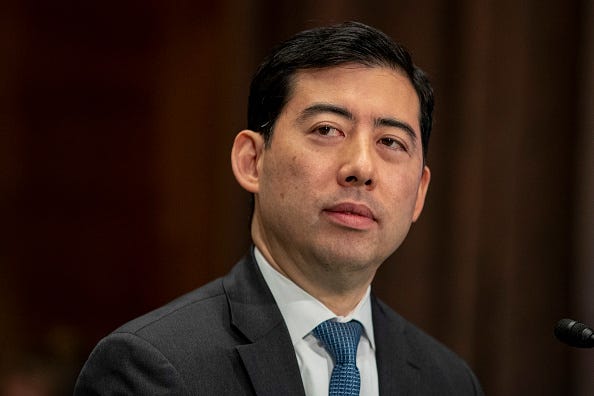
Capitol Account: The SEC has been very active since you took the helm. It seems like you and Peirce had a game plan.
Mark Uyeda: We did. This was something that started over the summer of 2024.
CA: Why prepare so early? You’ve been through a transition before, having worked for Trump’s acting SEC chairman in 2017.
MU: One of the mistakes we realized in hindsight was not starting the plan for the first several months of the new administration well in advance. So going into the election, we already had a list of things that we were concerned about and that needed to be addressed. This was something that Commissioner Peirce and I frequently discussed…That's one of the benefits of having commissioners in the minority party…We have our own staffs, we can do a lot of thinking and be ready on Day One.
CA: Speaking of being ready, SAB 121, the controversial accounting guidance for digital assets was repealed three days after the inauguration. How did you gear up for that?
MU: As staff action, it could be more easily addressed…But it was very important that when we rescinded it, we were aware of any potential unintended consequences…There was outreach to financial statement preparers, audit firms, [the Financial Accounting Standards Board]...We wanted to move thoughtfully and carefully. Because in the long run, that is how you have rules and regulatory guidance that will likely be upheld, widely accepted and stand the test of time.
CA: When did you start putting this in motion?
MU: Because this agency was still being run by Chair [Gary] Gensler it was only in those last few days up until the inauguration that the staff started being read into all the discussions that we've been having.
CA: You also quickly got rid of guidance issued under Gensler that made it harder for companies to keep shareholder proposals involving social issues off their proxy ballots. Why?
MU: To move back to our practice [of] how this agency has handled it for 40-plus years.
CA: What was the problem with the policy?
MU: A lot of shareholder resolutions were submitted that were much more prescriptive, that were about immaterial or special interest issues that didn't affect the company specifically. We looked at the number of shareholder proposals that were submitted in the following years – and they increased significantly. We also heard from a lot of asset managers who said they thought the quality of shareholder proposals had declined significantly.
CA: As acting chairman, you’ve also had to focus a lot on personnel – a pretty fraught issue these days as the Trump administration tries to radically downsize the government. How many people has the SEC lost?
MU: I don't want to get into specific numbers, but we had a fairly large number of our employees who did take either the voluntary early retirement program…or the deferred resignation program, which is also known as the `fork in the road’ option.
CA: Some have put the number at about 700 people, almost 15 percent of the staff.
MU: It's a good chunk. But if you look at our ability to carry out our mission, I don't have any concerns with the going-forward size of our workforce…We have a deep bench.
CA: You’ve spent a lot of your career at the SEC, first as a staffer and now a member of the commission. Does it worry you that the agency is losing talented people or that it could get cut to the bone?
MU: Well, we still are much larger than where we were when I first joined in 2006, which was pre-financial crisis…We're going to continue to attract high-quality staff, in my view, because the SEC is such a great place to work for anybody interested in finance and capital markets regulation.
CA: Do you see more workforce reductions coming?
MU: That's a question that you'll need to ask my successor.
CA: What have been your interactions with DOGE?
MU: We've been working with DOGE. I think it's an important function, to review how government agencies are doing their operations. Are they finding sufficient efficiencies? Are there areas where we're overspending? There are so many things that can accumulate at an agency, especially over years or decades...Are we spending those dollars that we collect from the public as efficiently as possible?…Even though we are funded by fees on the industry, it's still the public who is paying those fees – which, in my view, is a tax…(Friday)
Click here to subscribe and read the rest of the interview.
Thanks for reading. Follow us on X @CapitolAccount and on LinkedIn by clicking here. We’re always looking for stories, so if you have any suggestions on what we should cover (or comments about Capitol Account), shoot us a note. Rob can be reached at: rschmidt@capitolaccountdc.com and Ryan at rtracy@capitolaccountdc.com. If somebody forwarded this to you and you’d like to subscribe, click on the button below. Please email for information on our special rates for government employees, academics and groups: subscriptions@capitolaccountdc.com.
Big List: In his short time as Treasury secretary, Scott Bessent has made a point of highlighting his deep interest in financial oversight. This week, he fleshed out his ideas for a comprehensive regulatory overhaul – and emphasized that his department will be heavily involved in carrying it out.
Speaking at the American Bankers Association’s Washington Summit, Bessent outlined plans to address issues big and small, complex and granular. “I and the rest of the Treasury team will devote the necessary time and attention to the quite technical, substantive aspects of regulatory reform,” he said. Among the priorities: capital, supervision, liquidity, anti-money laundering requirements, deposit insurance and the regulatory agencies themselves.
The extensive agenda even seemed to take Rob Nichols, ABA’s president, slightly aback. “This, Mr. Secretary, is an ambitious, warranted and most welcome set of reforms,” he remarked. “How are you going to go about doing all that? That’s a big, big list.”
Bessent responded that he’s been assembling a crew of like-minded regulators – including nominees Jonathan McKernan, Jonathan Gould and Bowman – who can accomplish the mission. “I do believe policy is personnel, personnel is policy,” he said. Referring to himself as “the conductor,” Bessent added: “I've got a great orchestra, and we’re going to make great music.”
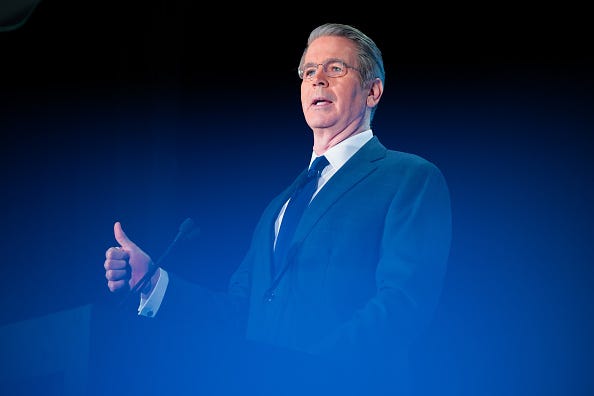
Bessent underscored that “in the past, bank regulators have exercised vast powers on almost every aspect of daily life – but without meaningful accountability to the American people.” President Trump, the secretary explained, “is correcting this” and has “tasked” Treasury with making sure agencies “fulfill their statutory mandates consistent with his priorities.”
Still, that doesn’t mean “ever-increasing budgets and employee head counts,” Bessent continued. “Regulators themselves should be efficient.”
Addressing some 1,400 bankers who are visiting Washington and meeting with lawmakers, the secretary centered his speech on easing rules affecting small lenders. “There may be strong cases for categorical exemptions of community banks from some entire regulations,” he said. “In particular, we will be taking a close look at the CFPB’s recent rules and the bank regulators’ expectations relating to internal controls. This will include, for example, third-party risk management and information security.”
Bessent described the reworking of supervision, already underway at the OCC and FDIC, as “perhaps the single most important reform.” Examinations, he said, will be focused on material financial risks to banks. “Regulators should keep the main thing the main thing,” he said.
To ensure that ethos sticks, the Treasury chief suggested…(Wednesday)
Click here to subscribe and read the full article.
Regulatory Advice: With Trump’s tariffs upending the financial markets, it was no surprisie that Jamie Dimon’s annual shareholder’s letter — warning of the economic fallout from a trade war — garnered a lot of headlines. But the JPMorgan Chase CEO used the lengthy document to offer detailed recommendations on regulatory policy.
Dimon, as many know, has a true fascination with Washington, and he’s never shied away from offering his unvarnished opinions on bank oversight. His thoughts may be especially worth parsing now that the industry is back on the offensive after four years of having little ability to influence rules, except in the courts.
Not surprisingly, the letter hit some of the bank lobby’s biggest bugaboos, including overwrought capital requirements and interchange fee caps. Still, the note wasn’t all doom and gloom. Dimon included some Trump-friendly commentary, singing the praises of public-sector “cost efficiencies” and declaring that “recent Democratic policies, driven by often-misguided narratives and an often-dismissive tone, have left much of the business community frustrated and disillusioned.”
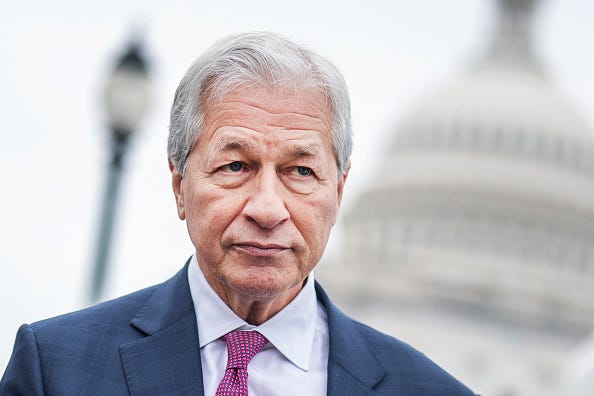
Stepping outside the commercial banking sector, Dimon outlined agenda items affecting retirement funds and the public markets. “Regulations should encourage, rather than discourage, companies to go public,” he asserted. And beyond financial services, the executive offered his take on healthcare, education and corporate management. In all, the missive clocked in at 29,000 words.
For those looking for more of a CliffsNotes version, here’s a rundown of the highlights involving financial regulation.
Tariffs and Trump: Dimon argued the president’s plans would “slow down growth,” potentially cause a recession and raise “domestic prices, as input costs rise and demand increases on domestic products.” Bigger picture, he said, “my most serious concern is how this will affect America’s long-term economic alliances.”
More broadly, though, the veteran CEO welcomed the change in tone in Washington. “The Republicans are right to champion business and free enterprise…and cut back on needless, mind-numbing, job-killing regulations,” Dimon wrote. He nodded to the GOP concerns about so-called weaponization of government, saying that federal agencies have been used “to attack parties, businesses and individuals, particularly those not in favor by the party in power.”
And he clearly had a few Biden-era appointees in mind when he wrote this passage:
“Many government agencies and regulators frequently criticize business by relying on oversimplified and dishonest concepts like ‘price gouging’ to justify their stance. They tend to take the isolated missteps of a few companies and use them to paint the broader business community as unethical. This fuels rhetoric that undermines free enterprise and leads to regulatory overreach that frequently exceeds the intent of the law. Few in the previous administration actually understood business or had any experience running a business – and it showed.”
As for deregulation, Dimon saw a lot of work to do. “There are hundreds of rules to fix,” he estimated…(Monday).
Click here to subscribe and read the full article.

Recommended: Like Capitol Account? Check out Open Banker. Open Banker curates and shares policy perspectives in the evolving landscape of financial services for free. It has quickly become essential reading for anyone interested in thoughtful arguments on where financial regulation should go. Click here to see recent articles and to subscribe.